
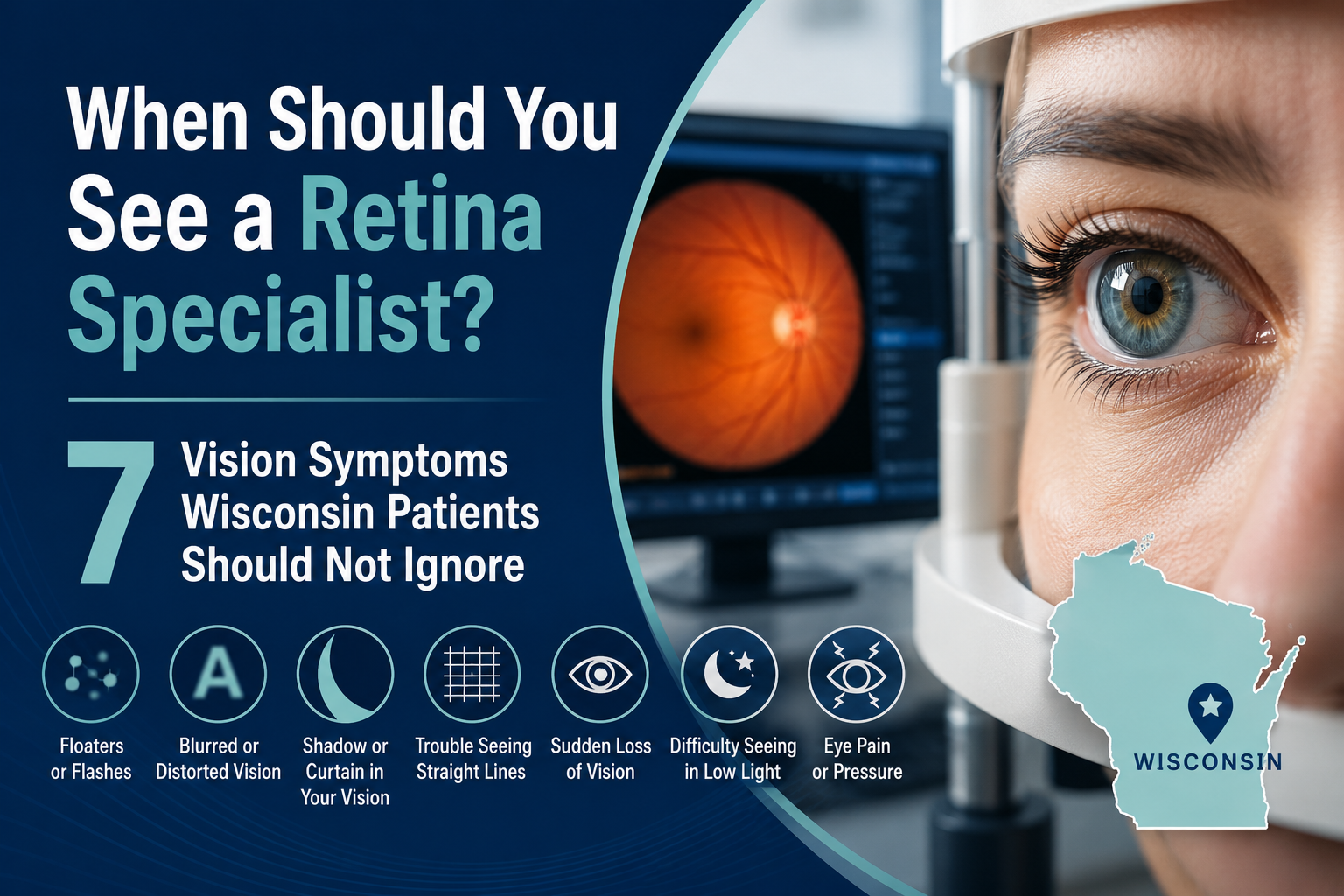
Your retina is the light-sensitive tissue at the back of your eye, and it plays a central role in how you see detail, movement, color, and the world directly in front of you. When something affects the retina, symptoms can sometimes appear suddenly and without pain. Other retinal conditions develop slowly, which is why a person may not realize there is a problem until reading, driving, recognizing faces, or seeing clearly becomes more difficult.
For patients in southeastern Wisconsin, knowing when to see a retina specialist can make an important difference. A retina specialist is an ophthalmologist with advanced training in diagnosing, monitoring, treating, and surgically managing diseases of the retina and vitreous. At Advanced Retina, our medical and surgical retina specialists care for patients in Greenfield, Pewaukee, Mequon, and the surrounding Wisconsin communities with advanced retinal imaging, treatment planning, and patient-centered guidance.
1. Sudden Floaters or a “Shower” of New Spots
Many people see an occasional floater, especially with age. Floaters may look like small specks, threads, cobwebs, or dark spots that drift through your field of vision. They are often caused by changes in the vitreous, the gel-like substance inside the eye. However, a sudden increase in floaters, especially when it feels like many new spots appeared at once, should not be ignored.
A sudden shower of floaters can occur when the vitreous pulls on the retina. In some cases, that pulling can lead to a retinal tear, which can progress to retinal detachment if fluid passes through the tear and lifts the retina away from the wall of the eye. Advanced Retina provides prompt evaluation and treatment for retinal tears, including therapies designed to seal the tear and reduce the risk of detachment. Please contact Advanced Retina immediately if you’re experiencing any of these symptoms at 262-510-0300.
2. Flashes of Light in One Eye
Flashes may look like lightning streaks, camera flashes, or brief flickers in the side of your vision. They can happen when the vitreous rubs or pulls on the retina. Although some flashes are not dangerous, new or frequent flashes, particularly when they occur with new floaters, deserve a dilated retinal exam.
Patients often search online for “flashes and floaters when to worry” or “retina specialist near me” because the symptom can be unsettling. The most important point is that new flashes should be taken seriously, especially if they are accompanied by floaters, peripheral vision changes, or reduced vision. A retina specialist at Advanced Retina can examine the far edges of the retina, identify tears or weak areas, and recommend treatment when needed. Please contact Advanced Retina immediately if you’re experiencing any of these symptoms at 262-510-0300.
3. A Curtain, Shadow, or Missing Area in Your Side Vision
A gray curtain, dark shadow, or missing area in peripheral vision is one of the most urgent retinal warning signs. The American Academy of Ophthalmology describes a shadow in side vision or a gray curtain over part of vision as a reason to contact an ophthalmologist right away, because these symptoms can occur with a torn or detached retina.1
Retinal detachment is a serious condition because the retina must remain attached to receive the support it needs to function. Without prompt care, permanent vision loss can occur. If you notice a curtain-like shadow, sudden side-vision loss, or rapidly worsening vision, call an eye care professional immediately or seek urgent medical care.
4. Blurry, Wavy, or Distorted Central Vision
Central vision is what you use to read, recognize faces, drive, sew, watch television, and see detail straight ahead. When straight lines begin to look wavy or bent, or when a blurred area appears near the center of your vision, the macula may be involved. The macula is the central part of the retina responsible for sharp, detailed vision.
One common condition that affects the macula is age-related macular degeneration, often called AMD. AMD can blur central vision, and later symptoms may include wavy lines, blurry central areas, blank spots, less vivid colors, and difficulty seeing in low light. Straight lines that suddenly appear wavy can be a warning sign that should be evaluated promptly.
A retina specialist can use diagnostic imaging, such as optical coherence tomography, to assess the macula and determine whether monitoring, injections, laser-based therapy, or another treatment plan may be appropriate depending on the diagnosis.
5. Vision Changes When You Have Diabetes
Diabetes can affect the small blood vessels in the retina. Over time, high blood sugar can damage these vessels, causing them to swell, leak, close off, or grow abnormal new vessels. This condition is called diabetic retinopathy and is a leading cause of blindness in working-age adults.
The challenging part is that diabetic retinopathy may have no symptoms in its early stages. When symptoms do occur, they may include blurry vision, dark floating spots, blank or dark areas, difficulty reading, distortion, or vision loss. This is why regular diabetic eye exams are so important, even when vision seems stable.
For patients with diabetes around the Milwaukee area and throughout southeastern Wisconsin, Advanced Retina offers diagnosis and management of diabetic retinopathy and related complications. Treatment may include close monitoring, medication injections, laser treatment, or surgery depending on the severity and findings on retinal examination.
6. Trouble Reading, Recognizing Faces, or Seeing in Low Light
Not every retina symptom arrives suddenly. Some changes develop gradually. If you notice that printed words look blurred, you need brighter light to read, faces are harder to recognize, or your vision does not adjust as well in dim settings, the macula may need evaluation. These symptoms can occur with macular degeneration and other retinal conditions.
Because one eye can sometimes compensate for the other, people may not notice vision changes until the condition has progressed. A practical way to monitor your vision is to periodically check each eye separately by covering one eye at a time. If one eye shows new distortion, blur, missing areas, or reduced central detail, schedule an eye evaluation.
7. Persistent Distortion After Eye Surgery, Injury, or a Previous Retina Diagnosis
Patients with certain risk factors may need retinal evaluation even if symptoms seem mild. Retinal tears are more likely in people with severe nearsightedness, prior eye surgery, trauma, a family history of retinal tears or detachment, or thin areas of the retina known as lattice degeneration. Advanced Retina’s retinal tear service page also notes that flashes
and floaters can be primary signs of a tear and that some tears may be detected during an eye exam even before major symptoms occur.
If you have already been told you have a retinal condition, new symptoms should be discussed with your eye care team. Conditions such as epiretinal membrane, macular hole, retinal vein occlusion, central serous chorioretinopathy, diabetic retinopathy, and macular degeneration can change over time and may require specialized monitoring or treatment.
What to Expect at a Retina Specialist Appointment
A retina appointment is more detailed than a routine vision check because the goal is to examine the retina and identify changes that may not be visible without specialized testing. At Advanced Retina, your first visit may include a review of your medical and eye history, dilation, retinal imaging, diagnostic testing, and a discussion with a retina specialist about findings and treatment options.
Patients should plan for their eyes to be dilated. Because dilation can blur vision and increase light sensitivity for several hours, it is often wise to bring a driver. You should also bring your insurance card, photo ID, medication list, and any eye drops you currently use. If your eye doctor referred you, Advanced Retina will coordinate with the referring provider to support continuity of care.
Why Choose Advanced Retina in Southeastern Wisconsin?
Advanced Retina focuses exclusively on medical and surgical retina care. The practice provides comprehensive evaluation and treatment for retinal tears, retinal detachment, diabetic retinopathy, age-related macular degeneration, central serous chorioretinopathy, epiretinal membrane, retinal vein occlusion, and macular hole. Patients have access to board-certified retina specialists, advanced diagnostic technology, and convenient offices in Greenfield, Pewaukee, and Mequon.
Just as important, retina care should be clear and understandable. A retinal diagnosis can feel overwhelming, especially when symptoms appear suddenly. The goal at Advanced
Retina is to explain what is happening, answer questions, coordinate with referring doctors, and guide each patient through the next step with confidence.
Protecting Your Vision Starts With Taking Symptoms Seriously
Some retina conditions are urgent. Others require careful monitoring over time. In both situations, early evaluation can help patients understand what is happening and what treatment options may be available. If you are experiencing sudden floaters, flashes, a curtain or shadow in your vision, distorted central vision, or diabetes-related eye changes, do not wait and hope the symptoms disappear.
To schedule an appointment with Advanced Retina, call 262-510-0300 or request an appointment online. With locations around Southeastern Wisconsin, Advanced Retina provides specialized medical and surgical retina care for patients across southeastern Wisconsin.
Where does Advanced Retina see patients?
Advanced Retina serves patients in southeastern Wisconsin with convenient locations in Greenfield, Pewaukee, and Mequon. Patients can call 262-510-0300 or use the online appointment request form to begin scheduling.